General
Lorem ipsum dolor sit amet, consectetur adipiscing elit.

Search

Lorem ipsum dolor sit amet, consectetur adipiscing elit.
Brain-focused science emphasizing learning, memory, behavior, perception consciousness and disorders.

Lorem ipsum dolor sit amet, consectetur adipiscing elit.
Your Body Has Been Keeping Score and Nobody Told You!
The irritability, the withdrawal, the tears that came from nowhere, science now knows about the nervous system behavior most people never notice in themselves. It may simply be SENSITIVITY!
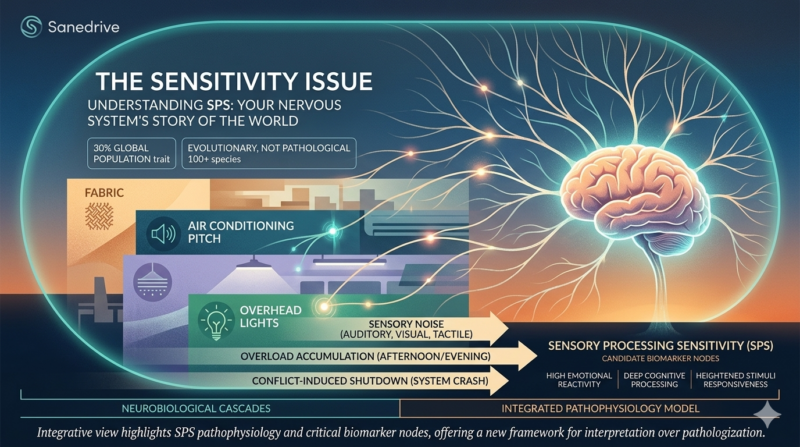
Think about the last time you became saucy for no apparent reason. Or left a party early and couldn’t explain why. Or found yourself crying in the car after an ordinary workday. We generally probably blamed stress, or mood, or the other person. Attention is drawing to some more things; the fabric, chair, the pitch of the air conditioning, or the flicker of the overhead lights. Science is now building a compelling associating mechanism between these environmental cues and our behavioural response.
For the past decade, researchers studying a trait called Sensory Processing Sensitivity (SPS) have been quietly dismantling one of the most stubborn myths in human self-understanding: the idea that our emotional reactions are primarily emotional in origin. What they are finding, across neurology, psychology, and behavioral science, is that a significant portion of what we experience as personality, including our irritability, our withdrawal, our social fatigue, begins in our nervous system’s encounter with the physical world.
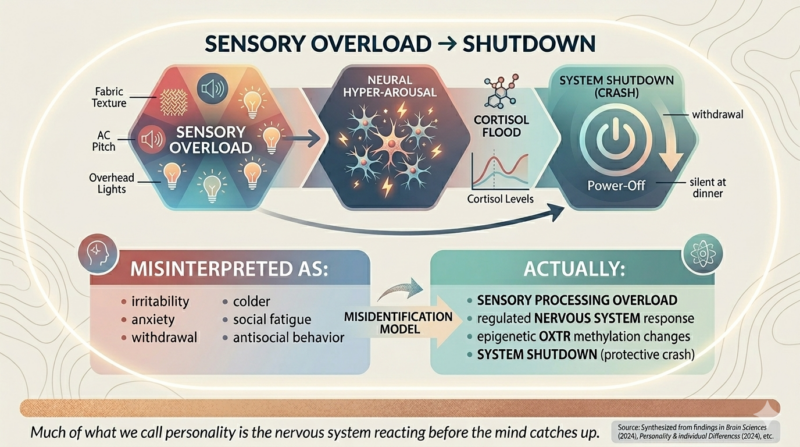
A rapidly growing body of research suggests that SPS is linked to measurable differences in sensory sensitivity as well as individual variation in brain structure and function. Greven and colleagues explains that SPS reflects increased sensitivity, reactivity, and deeper processing of stimuli, and that these differences arise from genetic and neurobiological factors, not merely emotional traits. A 2026 Scientific Reports study notes that SPS is characterized by lower sensory thresholds, heightened physiological reactivity, and deeper processing of environmental information, showing that many behavioural patterns (e.g., overstimulation, withdrawal, irritability) originate in sensory‑nervous system processing.
The Behavior No One Is Connecting
Consider the person who goes quiet at dinner parties, stops responding to messages after 7pm, or leaves early without a satisfying explanation. They are often labeled antisocial, introverted, even cold. But research from the Journal of Research in Personality shows that overstimulation reliably increases in the afternoon and evening, and in the company of others, with more sensitive individuals reporting significantly higher overstimulation when fatigued or surrounded by unpleasant auditory and visual input.
According to a 2024 review in Personality and Individual Differences, sensory processing sensitivity amplifies the negative aspects of environments and situations, and the resulting psychological distress can express itself as either internalizing behavior, depression, withdrawal or externalizing behavior, including aggression and impulsivity. Your partner may not be having a character failure after a loud day in an open-plan office. It may be their nervous system running a tab, and someone just asked for the bill.
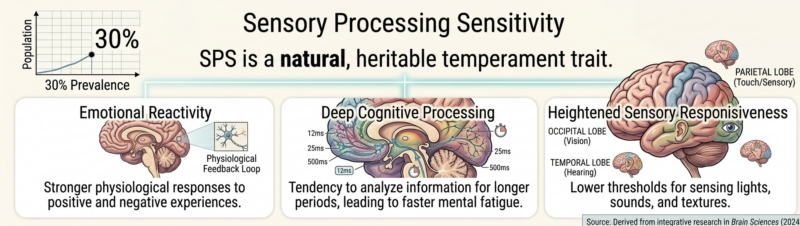
For highly sensitive people, conflict can trigger a physiological stress response so intense that their nervous system effectively shuts down. Cortisol spikes, heart rate rises, and they become unable to speak, argue, or express emotion. While this shutdown may look like stonewalling or emotional withdrawal from the outside, internally it feels like a system crash. This is a reaction neither person in the interaction usually has the language to explain.
The consequences of this misreading are not trivial. Relationships fracture over behaviors that were never chosen. Careers stall because environments are never adapted. People spend years, sometimes entire adult lives in therapy processing what they believe to be emotional wounds, without ever learning that the original input was a stimulus.
The Neurodivergent Amplification
Neurodivergent people experience the same sensory mechanisms as everyone else, but at a much higher intensity. Research published in Frontiers in Psychiatry (2024), shows that sensory over‑responsivity cuts across autism, ADHD, anxiety, and typical development, and is strongly linked to mental‑health challenges. The difference is the intensity and how well the world accommodates their sensory thresholds. This is precisely why the conversation about sensory sensitivity cannot remain housed inside the neurodiversity community. The mechanisms are shared. A neurotypical person may leave a loud event feeling drained. An autistic person may leave the same event in physiological crisis. One experience is treated as a personal preference. The other is treated as a disorder.
Naming this Trait does not Dissolve It.
What knowing about this will do is to transform the interpretation of it, and interpretation turns out,to be where most of the damage gets done. The research is pointing somewhere specific, and it is not toward treating sensitivity as a deficit to be corrected. It is pointing toward building environments, relationships, and self-understandings that account for the fact that human nervous systems have never been uniform and that much of what we have been calling personality is, in fact, the body responding to the world before the mind has had a chance to catch up.
One in three people is doing this right now. The question is whether we will finally understand it and they will try to also adjust so we have a saner world.
Cited Research Papers
Greven, C. U., Trupp, M. D., Homberg, J. R., & Slagter, H. A. (2025). Sensory processing sensitivity: theory, evidence, and directions. Trends in Cognitive Sciences.
Weyn, S., Greven, C. U., Schmidt, S. J., & Gillebert, C. R. (2026). Sensory processing sensitivity and overstimulation in daily life. Scientific Reports
Weyn, S., Greven, C. U., & Gillebert, C. R. (2025). Daily fluctuations in overstimulation: The role of sensory processing sensitivity in everyday environments. Journal of Research in Personality, 105, 104–118.
Lionetti, F., Aron, E. N., Aron, A., Klein, D. N., & Homberg, J. R. (2024). Sensory processing sensitivity: A review of biological, psychological, and social mechanisms. Personality and Individual Differences, 215, 112–126.
Green, S. A., Hernandez, L., Tottenham, N., & Baranek, G. T. (2024). Sensory over-responsivity as a cross-diagnostic mechanism: Evidence across autism, ADHD, anxiety, and typical development. Frontiers in Psychiatry, 15, Article 1324578.
Hannah
Thank you for sharing