General
Lorem ipsum dolor sit amet, consectetur adipiscing elit.

Search

Lorem ipsum dolor sit amet, consectetur adipiscing elit.
Brain-focused science emphasizing learning, memory, behavior, perception consciousness and disorders.

Lorem ipsum dolor sit amet, consectetur adipiscing elit.
The Neuroscience of Your Perfume
You picked your perfume this morning without thinking too hard about it. But your brain did.
Before you finished getting dressed, that fragrance was already inside the most emotionally charged circuits in your brain, controlling how you’d feel, what you’d remember, and how reactive you would be to stress for the hours that followed. Across cultures, people have said it for centuries: some perfumes bring good energy. Others carry a bad omen. Some scents feel holy. Others feel threatening. Science has quietly worked to prove they were right: just for reasons nobody expected!
A little dive in……
Why Scent Is Different From Every Other Sense
Every sense you have sight, sound, touch, taste passes through a relay station in the brain called the thalamus before it reaches your cortex. The thalamus acts as a gatekeeper: it filters, organizes, and presents information to your thinking brain.
Smell is the only sense that skips this entirely.
Odor molecules bind to receptors in your nose and travel directly to your amygdala and hippocampus, which is the brain’s emotional processing center and memory archive. No checkpoint. No filter. No translation.
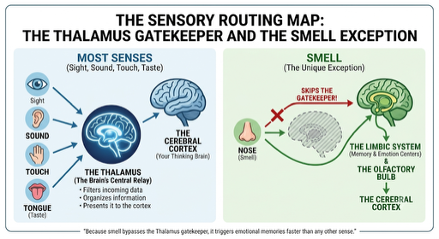
This means a scent reaches your emotional brain before your thinking brain has processed it. Before you decide whether you like a smell, your amygdala has already responded to it. Before you recognize what you’re smelling, your hippocampus has already matched it to a memory.
This is why scent is the most emotionally loaded of all the senses. And it is why your perfume is not neutral.
When people say a perfume carries good or bad energy, that it attracts good fortune or invites darkness, they are describing something real. They are simply describing it in the language available to them.
When a scent is called “holy” or “protective”: The compound profile is activating GABA, serotonin, or oxytocin pathways. The person wearing it enters social interactions calmer, more grounded, more open. They read situations more accurately. They make better decisions. They are perceived as warmer. The outcomes improve. The scent appears to have brought good fortune. It has through neurochemical signaling.
When a scent is called “bad omen” or “threatening”: Either the compound profile is activating threat-detection in the amygdala, or more commonly the scent has been encoded to a traumatic or negative memory. Because olfactory memories bypass the thalamus on their way in, the result is a fully embodied threat response triggered by a smell. The person becomes hypervigilant, reactive, and socially withdrawn. Outcomes worsen. The perfume “brought bad luck.”
The mechanism is not supernatural neither is it trivial. A scent that consistently activates your HPA axis, elevating cortisol, keeping your nervous system in low-grade fight-or-flight will, over time, affect your sleep quality, your immune function, your emotional reactivity, your relationships, and your cognitive performance. That is not an omen but physiology.
Frankincense in every major religion: Incensole acetate. TRPV3 activation. Documented anxiolytic and antidepressant effect in peer-reviewed literature. When your grandmother said the church incense brought peace may be correct.
You are not wearing decoration. You are, every day, making a neurochemical choice about which receptor systems your brain will run on.
A scent that activates your HPA axis before a high-stakes meeting is not a neutral choice. A scent that modulates GABA before a difficult conversation is not a neutral choice. A scent that triggers a dormant threat-memory every time you open your wardrobe is not a neutral choice.
The people who said perfume is spiritual were not wrong. They just didn’t know the mechanism.
Let’s explore what different perfume does to the brain
Scents That Trigger Anxiety and Panic
Not all scents are calming. Certain fragrance compounds activate the amygdala’s threat-detection system, triggering the same cascade as a perceived danger. For instance:
Sharp synthetic aldehydes at high concentrations (the aggressive, metallic top notes in many classic perfumes) can overstimulate the olfactory nerve and trigger a sympathetic nervous system response like elevated heart rate, shallow breathing, heightened alertness shading into unease.
Animalic and musky, fecal-adjacent compounds historically used in heavy oriental fragrances, can activate threat-detection pathways in the amygdala. The brain evolved to treat those signals as warnings. At low concentrations they read as “warmth.” At high concentrations or in the wrong context, they trigger the fight-or-flight cascade: cortisol release, adrenaline, hypervigilance.
Camphor (found in many medicinal and ritual fragrances) directly stimulates the trigeminal nerve the same pathway that processes pain and irritation. High doses causes anxiety. In small amounts it reads as “cleansing.” Overwhelm it and you are activating a stress response, not neutralizing one.
Heavy synthetic musks (nitromusks and polycyclic musks) have been shown to interfere with GABA receptor function. The brain’s primary inhibitory system. GABA is what keeps the nervous system from overfiring. When disrupted, the result is low-grade anxiety that the person cannot source.
Scents that Produce Calmness
Linalool found in lavender, bergamot, and coriander, binds to GABA-A receptors. GABA is the same receptor system targeted by benzodiazepines (Valium, Xanax). Linalool does not produce the same magnitude of effect as pharmaceutical anxiolytics, but the mechanism is identical.
Incensole acetate, the active compound in frankincense, activates ion channels in the brain (TRPV3) that produce warmth, openness, and reduced fear-signaling. This has been documented in peer-reviewed neuroscience. This is one of the reason you find it in use in religious gatherings, the ancients were, unknowingly, doing pharmacology.
Alpha-santalol (sandalwood) modulates serotonin 1A receptors: the same receptors targeted by SSRI antidepressants. The effect is stabilizing mood, (see why some people buy flowers just to smell it) not sedating
Vetiver used extensively in Ayurvedic medicine and West African spiritual practice (Jema in Hausa), produces parasympathetic activation. It slows the nervous system down. The result is a reduction in cognitive rumination, physical tension, and the sense of groundlessness that precedes anxiety
Scents That Elevates Mood
| Compound | Found In | Brain Target | Effect |
|---|---|---|---|
| Limonene | Citrus: orange, lemon, grapefruit | Dopamine + serotonin turnover | Rapid mood lift; normalises neuroendocrine hormones in depressed patients, some reduced antidepressant dose under medical supervision (EBCAM, 2014) |
| Phenylethylamine (PEA) | Rose absolute | Dopaminergic signalling via trace amine system | Activates the same neurochemical pathway as romantic infatuation. Rose is romantic because of this molecule |
| Vanillin | Vanilla | Oxytocin-adjacent response | Warmth, safety, social comfort. Likely encoded early, vanilla compounds overlap with breast milk volatiles, making this among the earliest pleasant olfactory memories in human life |
| Methyl jasmonate + Benzyl acetate | Jasmine | Beta-endorphin modulation | Mild, clear euphoria without sedation, the same system activated by exercise and social bonding |
Scents That Can Suppress Mood
| Type | Mechanism | What It Feels Like | Key Distinction |
|---|---|---|---|
| Heavy, unvarying base notes (dense resins, tobacco, certain musks) | Continuous single-compound amygdala signal → serotonin-mediated positive affect suppressed | Not calm, flatness. Emotional saturation from olfactory habituation | The amygdala stops responding variably; effect goes grey, not quiet |
| Synthetic musks | Emotional blunting: reduces intensity of both positive and negative responses | Neither happy nor sad. Dampened range across all affect | This is not calmness. Calm = regulated arousal. Blunting = suppressed arousal. These are neurologically distinct states |
The Bottom Line is Choose it accordingly.
References
Herz RS (2004). A naturalistic analysis of autobiographical memories triggered by olfactory visual and auditory stimuli. Chemical Senses.
Kagawa D et al. (2003). The in vitro biological activity of bisabolol oxides from German chamomile.
Russo EB (2011). Taming THC: potential cannabis synergy and phytocannabinoid-terpenoid entourage effects. British Journal of Pharmacology.
Moussaieff A et al. (2008). Incensole acetate, an incense component, elicits psychoactivity by activating TRPV3 channels in the brain. FASEB Journal.
Komori T et al. (1995). Effects of citrus fragrance on immune function and depressive states. Neuroimmunomodulation.
Moss M, Cook J, Wesnes K, Duckett P (2003). Aromas of rosemary and lavender essential oils differentially affect cognition and mood in healthy adults. International Journal of Neuroscienc