General
Lorem ipsum dolor sit amet, consectetur adipiscing elit.

Search

Lorem ipsum dolor sit amet, consectetur adipiscing elit.
Brain-focused science emphasizing learning, memory, behavior, perception consciousness and disorders.

Lorem ipsum dolor sit amet, consectetur adipiscing elit.
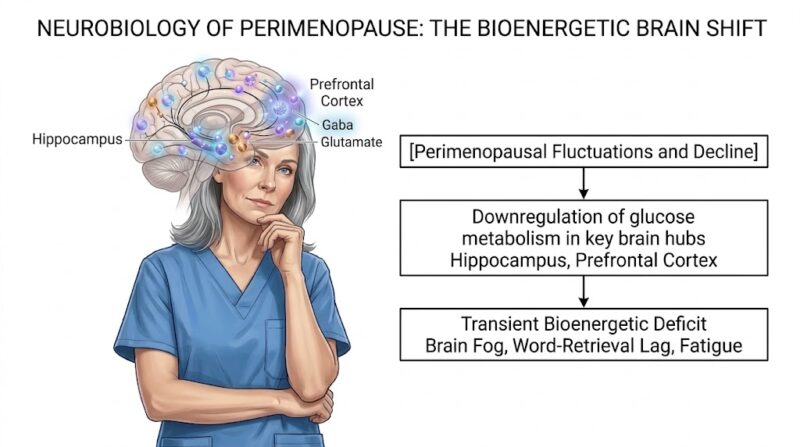
Say you walk into the kitchen and completely forget why you are standing in front of the open pantry.
A word you have used ten thousand times vanishes mid-sentence.
At 3:15 AM, you jolt awake soaked in sweat, heart racing, mind spinning over an email/event from three days ago.
And then comes the unspoken terror: Is this early dementia? Am I losing my edge? What is happening to me?
Let’s answer that immediately with clinical neuroscience: No. You are not losing your mind. Your brain is running an energy recalibration program. Let’s see more…….
For decades, medical science framed perimenopause almost exclusively as a reproductive event: ovaries winding down, periods turning irregular, hot flashes flaring up. But neuroimaging and molecular neuroscience evidence tell a radically different story:
perimenopause is fundamentally a neuroendocrine rewiring of the female brain.
Estrogen is not only a fertility/reproductive hormone. In the central nervous system, 17β-estradiol is a master bioenergetic and neuroprotective regulator. When its levels begin erratic fluctuations,
often starting 4 to 10 years before the final menstrual period, the neurons feel every tremor and respond to it.
Now let’s see what medical science reveals on the specific neurological warning signs to track, and five daily, evidence-based protocols to protect your neuronal health at this period.
To understand perimenopausal brain fog, we have to first look at the brain’s power plants: the mitochondria.
A significant PET scan research led by neuroscientist Dr. Lisa Mosconi at Weill Cornell Medical College, New York, demonstrated that during perimenopause, cerebral glucose metabolism can drop by up to 20–30% in specific regions:
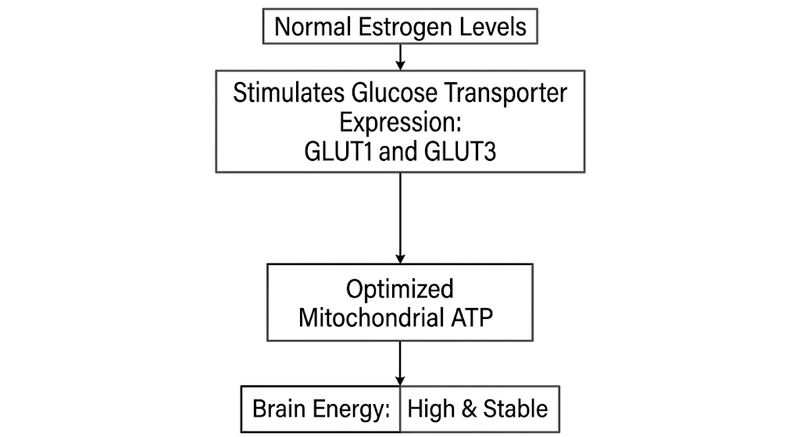
Estrogen pushes glucose into neurons and instructs mitochondria to churn out ATP efficiently. When estrogen swings or drops, neurons experience a temporary bioenergetic shortfall. The brain has to adapt by tapping into alternative fuels (such as ketone bodies and lactate) and remodeling its neural circuitry.
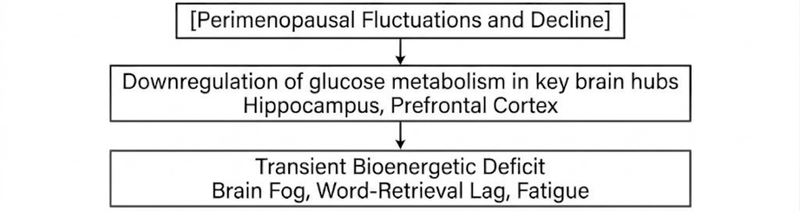
In plain English: The brain is retooling its engine while driving down the highway. The forgetfulness and fatigue aren’t damage; they are the friction of metabolic adaptation.
Hot flashes are usually not a skin issue, but a hypothalamic misfiring.
The hypothalamus contains the brain’s internal thermostat. Estrogen helps define what is known as the thermoneutral zone: the narrow temperature band where our body feels neither too hot nor too cold.
Slow-wave sleep is when the brain’s glymphatic system activates, washing out metabolic waste, including beta-amyloid plaques. When nighttime hot flashes fragment this cycle, you wake up not just tired, but with un-cleared metabolic debris, dulling your focus the next day.
Perimenopause symptoms are often dismissed as “just stress” or “burnout.” Watch for these five neurological signals that reflect changing cerebral chemistry:
| Signal | What It Feels Like | Neurological Mechanism |
|---|---|---|
| Word-Finding Delay (Anomia) | “The word is right on the tip of my tongue, but the drawer won’t open.” | Reduced estrogenic activation in Broca’s and Wernicke’s speech-processing networks. |
| Spatial & Working Memory Slips | Missing exits on familiar drives; forgetting what you just walked into a room to grab. | Transient glucose hypometabolism in the hippocampus. |
| Sudden Sensory Overload | Background noise in restaurants, loud appliances, or bright lights suddenly feel unbearable. | Drop in GABA (the brain’s primary calming neurotransmitter), lowering the sensory gating filter. |
| New-Onset Migraines / Auras | Severe, throbbing, one-sided headaches appearing right before menstrual spotting. | Estrogen withdrawal provoking cortical spreading depression and trigeminovascular activation. |
| Flat-Lined Emotional Buffer | Going from zero to intense rage or tearfulness over minor friction. | Altered serotonin transporter binding and blunted amygdala-prefrontal connectivity. |
Neuroplasticity does not end at 40. The brain is an adaptable organ, and supporting its metabolic shift makes the transition smoother and protects long-term cognitive reserve.
When brain glucose metabolism is vulnerable, glycemic rollercoasters amplify brain fog tenfold. Every glucose spike is followed by a reactive dip that starves an already fuel-sensitive brain.
To help neurons produce energy when estrogen signals dip, you need more mitochondria.
Because the brain flushes out toxins during deep sleep, temperature management is non-negotiable.
Neurons thrive on cognitive friction. Building new synaptic pathways compensates for areas undergoing metabolic shifts.
The “Window of Opportunity” hypothesis in neuroprotection indicates that Menopausal Hormone Therapy (MHT) has the most positive cognitive and cardiovascular profile when initiated early in the transition (during perimenopause or within 10 years of menopause onset), before vascular damage or permanent neuronal remodeling occurs.
Perimenopause is an evolutionary, neurobiological phase change.
The brain is shedding its reproductive wiring and building its post-reproductive operating system. The fog, the heat, and the emotional turbulence are practical, measurable neurological phenomena, not personal to you, not stress you imagined, and not a permanent decline.
When you understand the mechanisms, you can manage the symptoms and start giving your neurons the exact metabolic and structural support they need.