General
Lorem ipsum dolor sit amet, consectetur adipiscing elit.

Search

Lorem ipsum dolor sit amet, consectetur adipiscing elit.

Brain-focused science emphasizing learning, memory, behavior, perception consciousness and disorders.

Lorem ipsum dolor sit amet, consectetur adipiscing elit.
What New Research Reveals About Microchimerism
For decades, scientists believed the human brain was a closed world, sealed off, protected, and genetically uniform. But new evidence is rewriting that story.
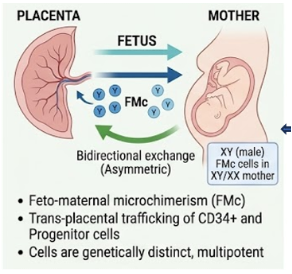
During pregnancy, a small number of cells cross between mother and fetus. Some of these cells travel farther than anyone expected. They slip through the blood-brain barrier, settle into brain tissue, and stay there for decades. This phenomenon is called feto‑maternal microchimerism, and it’s turning out to be one of the most intimate biological connections ever discovered.
Dr. Nosarieme’s latest publication in the American Journal of Reproductive Immunology explores this hidden cellular legacy, how it forms, how it behaves, and how it may shape neurological health across a lifetime. Some highlights are below;
A Two‑Way Biological Exchange
Microchimerism isn’t just fetal cells entering the maternal body. It’s bidirectional.
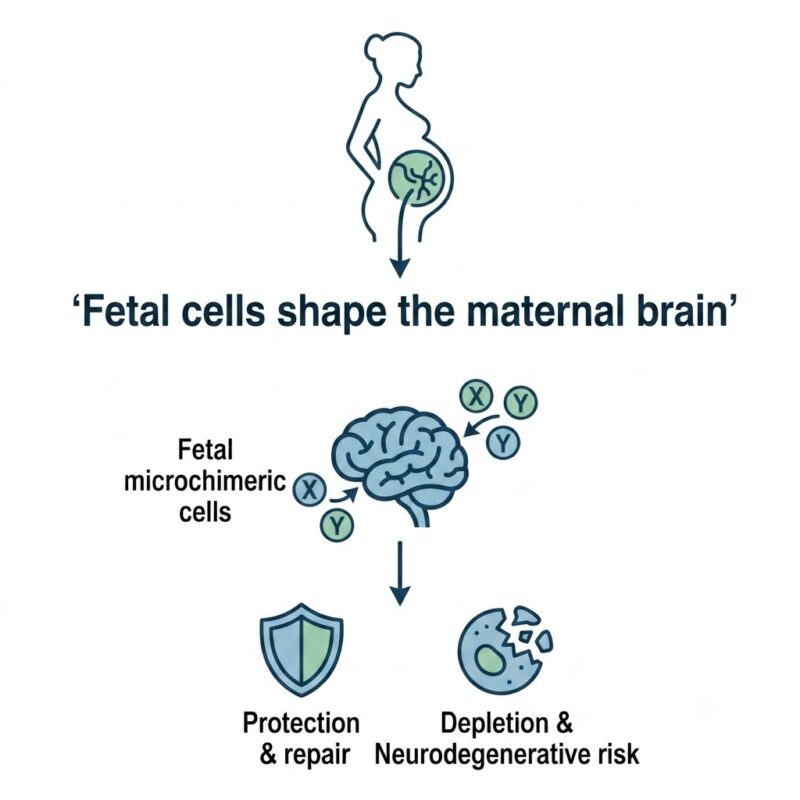
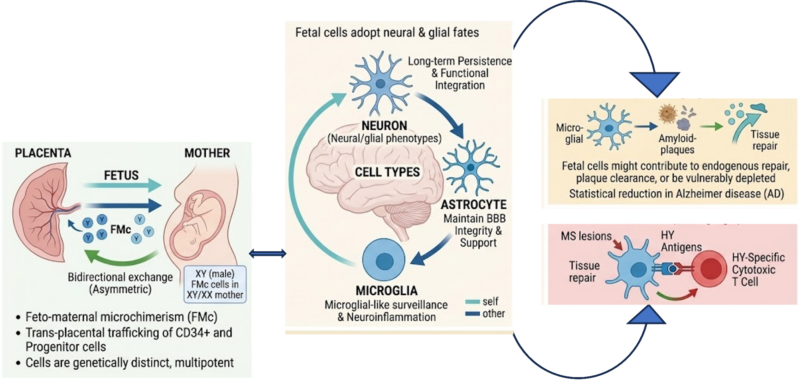
Recent single‑nucleus sequencing studies show these cells are not just passive passengers. They express distinct neural identities, including cortical projection neurons, astrocytes, microglia, and endothelial cells and they participate in local brain functions.
This means the human brain is not purely “self.” It carries a cellular imprint of pregnancy that lasts a lifetime.
Microchimerism and Neurological Disease
Abey (2026) review highlights emerging evidence linking microchimerism to several neurological conditions:
These findings don’t yet prove causation, but they suggest microchimerism may influence neuroimmune signaling, tissue repair, and vulnerability to disease.
The Experimental Frontier
Beyond natural microchimerism, scientists are now building experimental chimeric brain models using human stem‑cell–derived neurons and glia transplanted into rodent brains.
These models show:
Together, natural and experimental chimerism are revealing new pathways for understanding and potentially treating neurological disease.
Why This Matters
It may help protect the brain. It may influence disease. It may shape neurodevelopment in ways we are only beginning to understand.
Abey (2026) AJRI paper brings together decades of scattered evidence into a single mechanistic framework, one that could reshape how we think about brain immunity, maternal health, and neurological repair.
Read the Full Paper
Learn More Feto‑Maternal Microchimerism and the Brain: Mechanisms, Neurological Implications, and Translational Perspectives (Available through the American Journal of Reproductive Immunology. Read only link here: https://onlinelibrary.wiley.com/share/author/IN7RB53DQXCQ7BTWYU8W?target=10.1111/aji.70317)
Join the Conversation